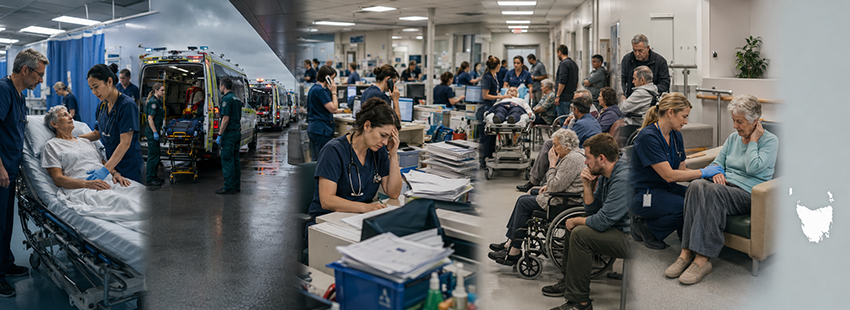
North-West Tasmania’s Health System Is Failing Its Greatest Test
People living in North-West Tasmania do not expect every specialised medical service to be available in every small town. They do, however, have a right to expect emergency care, heart and stroke treatment, rehabilitation and support after leaving hospital to be available within a safe and reasonable distance.
The evidence shows that this expectation is not being met.
North-West Tasmania has an older population, high levels of chronic disease and communities separated by considerable travelling distances. Yet its hospital and community health services remain stretched, fragmented and too dependent on transferring patients to Launceston.
This is not a criticism of our doctors, nurses, paramedics and allied health workers. They continue to work under extraordinary pressure. It is a criticism of a system that asks them to meet growing demand without the local services, staffing and infrastructure the region requires.
The emergency system is not meeting its own targets
Official figures provided to the Tasmanian Parliament in June 2026 show that, between July 2025 and March 2026, only 49.5% of patients at the North West Regional Hospital completed their emergency department stay within four hours. At the Mersey Community Hospital, the figure was 65.6%.
The accepted target is 90%.
Across the 12 months to March 2026, not one Tasmanian emergency department achieved that target on a single day.
The same parliamentary information revealed 837 unfilled ambulance night shifts in the North-West during 2025–26 to that point. An ambulance roster that cannot consistently fill its night shifts places patients, paramedics and entire communities at risk—particularly in rural areas where the next available crew may be a considerable distance away. Tasmanian Parliament—Health Minister’s 2026 answers
These are not abstract performance measures. They represent people waiting in pain, ambulances unavailable for the next emergency and exhausted health workers attempting to manage demand in an overcrowded system.
Heart disease is a North-West emergency
The Tasmanian Government has acknowledged that Tasmania has the highest rates of cardiovascular disease in Australia. Its response is the planned Northern Heart Centre at the Launceston General Hospital, with 24 cardiac beds and two cardiac catheterisation laboratories.
That development is welcome, but construction is not expected to be completed until late 2029—and it will be in Launceston, not the North-West. Northern Heart Centre announcement
For patients from Burnie, Smithton, Stanley, Queenstown, Rosebery and other North-West and West Coast communities, “regional access” can still mean a long road or ambulance transfer to Launceston.
That matters because heart attacks are time-critical. A blocked coronary artery does not recognise regional boundaries or wait for an ambulance transfer to become available.
The North West Regional Hospital provides cardiac assessment and treatment, but the government’s major cardiac catheterisation investment remains centred in Launceston. North-West Tasmania still has no public cardiac catheterisation laboratory capable of providing local coronary angiography, angioplasty and stenting.
The government must publish a transparent assessment of the demand, workforce requirements and clinical case for establishing public cardiac catheterisation capability at Burnie. The possibility should not be dismissed simply because a new centre is eventually being built more than 100 kilometres away.
The stroke figures should alarm us
The Stroke Foundation estimates that approximately 2,845 people in the federal electorate of Braddon are living with the effects of stroke. Of those people, about 17% are under 65.
The same research estimates that in Braddon:
-
Approximately 20% of residents have high blood pressure.
-
8.8% have diabetes.
-
Around 14% have high cholesterol.
-
Approximately 9.4% are daily smokers.
-
Almost 66% are overweight or obese.
These are major risk factors for stroke and cardiovascular disease. The Stroke Foundation also reports that more than 80% of strokes may be preventable. Stroke Foundation—Braddon profile
North-West Tasmania therefore needs more than emergency treatment after a person suffers a stroke or heart attack. It needs a serious prevention and early-detection program.
That should include accessible cardiovascular risk assessments, blood-pressure checks, cholesterol and diabetes testing, detection of atrial fibrillation, smoking cessation assistance and clinically appropriate vascular imaging. People identified as high risk must have an affordable pathway to specialist assessment—not simply be placed on another waiting list.
Treatment cannot end at the hospital door
Surviving a heart attack or stroke is often the beginning of a long recovery.
A stroke survivor may require physiotherapy, occupational therapy, speech pathology, psychological support, home modifications, transport, personal care and assistance navigating Centrelink, aged care or the NDIS. Their partner or family may suddenly become an unpaid, untrained, round-the-clock carer.
Tasmania does have publicly funded community nursing, rehabilitation and rapid-response services. However, availability does not necessarily mean timely or adequate access—particularly outside Burnie and Devonport.
Practical assistance is divided between the Tasmanian Health Service, Commonwealth aged-care programs, the NDIS, private providers and non-government organisations. Each has different eligibility rules, assessments, waiting lists and responsibilities.
A person can be considered medically ready to leave hospital while their home and family are completely unprepared to support them.
Primary Health Tasmania’s 2025–28 needs assessment recorded that 2,221 Tasmanians approved for a Home Care Package were still waiting for one at the end of December 2024. It also found that rural and remote older people were underrepresented across aged-care services, despite their level of need. Primary Health Tasmania Health Needs Assessment 2025–28
When adequate support is unavailable, patients remain in hospital longer, return to an emergency department or place unsustainable pressure on family members. The result is more hospital bed block, more cancelled procedures and greater long-term expense to government.
Outsourcing responsibility does not remove public responsibility.
What North-West Tasmania needs
North-West Tasmania requires an integrated, publicly accountable health plan that covers prevention, emergency treatment, specialist intervention, rehabilitation and long-term recovery.
That plan should include:
-
Proper staffing of the North West Regional and Mersey hospitals, with transparent publication of vacancies and unfilled shifts.
-
A guaranteed minimum level of ambulance coverage for North-West and West Coast communities.
-
A permanent specialist stroke service with coordinated acute treatment and rehabilitation.
-
A publicly released assessment and implementation plan for cardiac catheterisation capability at Burnie.
-
Expanded public cardiac and stroke rehabilitation, including home-based services.
-
Multidisciplinary discharge teams responsible for ensuring that support is operating before a vulnerable patient returns home.
-
Publicly operated short-term home support covering personal care, meals, transport and household assistance while people wait for aged-care or NDIS services.
-
Greater access to physiotherapy, occupational therapy, speech pathology, psychology and social work across the region—not only in the major centres.
-
Regular public reporting of emergency waiting times, transfers, treatment delays, rehabilitation access and patient outcomes.
-
A regional cardiovascular prevention and screening program based on age, risk and clinical need.
Regional Tasmanians should not receive second-class care
Governments frequently announce new buildings, strategies and future plans. But a health system must be judged by what happens when someone experiences chest pain in Smithton, stroke symptoms in Queenstown or a medical emergency in Burnie when ambulance and hospital rosters are already stretched.
It must also be judged by what happens after that person survives.
Do they receive rehabilitation? Can they obtain help at home? Is their family supported? Can they afford to travel to repeated appointments? Or are they discharged into a maze of waiting lists, providers and eligibility rules?
North-West Tasmania does not need another promise that services will improve eventually. It needs a properly staffed, locally accessible and publicly accountable health system now.
Heart attack and stroke patients cannot wait until 2029. Neither should the people of North-West Tasmania.