A New Integrated Hospital Campus for North-West Tasmania
A public–private shared-services model for Burnie
North-West Tasmania needs a serious discussion about what its hospital system should look like over the next 30 to 50 years.
Rather than continuing to expand existing facilities piece by piece, this paper proposes investigating a completely new hospital campus on a suitable new site in or near Burnie.
The existing North West Regional Hospital and North West Private Hospital could continue operating while the new campus was designed and constructed. This would avoid trying to rebuild a major hospital around patients, staff and existing services.
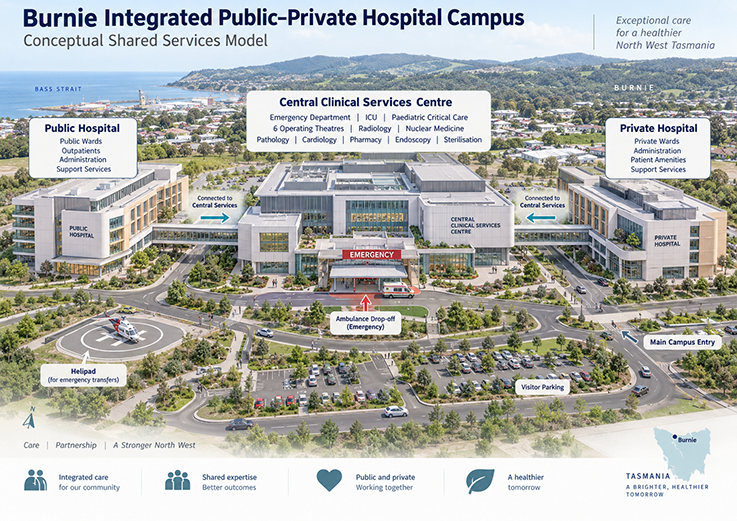
The new campus would be based on a different model from the traditional separation of public and private hospitals.
It would consist of three interconnected components:
A Central Clinical Services Centre, providing the major shared clinical infrastructure.
A Public Hospital, containing public wards and public-specific services.
A Private Hospital, containing private wards and private-specific services.
The central concept is straightforward:
Build the expensive clinical infrastructure once, allow both hospitals to use it, and charge each hospital for the services its patients consume.
Why consider a completely new site?
The existing Burnie hospital precinct has served the region for decades, but continuing to expand on a constrained site can create compromises.
A new-site development could provide an opportunity to design the entire hospital system properly from the beginning.
A suitable site in or around Burnie could potentially provide:
-
sufficient land for the complete hospital campus
-
room for future expansion
-
easier ambulance access
-
a dedicated helipad
-
substantially more parking
-
better traffic separation
-
space for medical training and research
-
accommodation for visiting specialists and patient families
-
future allied health and specialist medical facilities
-
the possibility of supporting services and medical businesses developing around the precinct.
Where necessary, the Tasmanian Government could examine rezoning appropriate land for health and associated infrastructure, subject to normal planning, environmental, transport and community consultation requirements.
The important point is that the hospital should not be designed around the limitations of the existing site if another location can provide a better long-term result.
The proposed campus
1. Central Clinical Services Centre
The central building would be the clinical heart of the campus.
It would be separately governed and would provide services to both the public and private hospitals.
Proposed services could include:
-
Emergency Department
-
Intensive Care Unit
-
paediatric critical-care capability
-
six operating theatres
-
recovery and perioperative services
-
cardiac catheterisation
-
coronary and cardiac services
-
radiology
-
CT
-
MRI
-
ultrasound
-
X-ray
-
interventional radiology
-
nuclear medicine
-
pathology
-
blood bank
-
pharmacy
-
endoscopy
-
sterilisation
-
specialist procedural rooms
-
other high-cost diagnostic and acute-care services.
This avoids the need to build parallel public and private versions of the same expensive facilities.
2. Public Hospital
The public hospital building would contain services that properly belong to the public hospital system.
These could include:
-
public medical and surgical wards
-
maternity
-
paediatrics
-
rehabilitation
-
public outpatient services
-
administration
-
patient accommodation
-
food services
-
other support functions.
When a public patient used Emergency, ICU, theatre, imaging, pathology or another central service, the Central Clinical Services Centre would charge the public hospital for that activity.
The public hospital would then be responsible for the patient’s ward care and other public hospital services.
3. Private Hospital
The private hospital would remain a separately managed and funded hospital.
It could contain:
-
private medical and surgical wards
-
maternity where viable
-
rehabilitation
-
administration
-
patient accommodation
-
private-hospital support services.
However, it would not need to duplicate the major clinical infrastructure already available in the central building.
Private patients would use the same theatres, ICU, imaging, pathology and other facilities as public patients.
The difference would be financial rather than clinical.
The private hospital or applicable private funding arrangement would pay the Central Clinical Services Centre for the services used by its patients.
One Emergency Department
There should be one Emergency Department serving the entire campus.
A seriously ill person should not have to decide whether they belong in a public or private emergency department.
Patients would be triaged and treated according to clinical need.
Treatment would always come first.
Once the patient’s immediate condition was stabilised, the appropriate funding arrangements could be established.
A public patient would subsequently enter the public hospital system.
A privately funded patient could enter the private hospital system.
Both would continue to have access to exactly the same central clinical facilities.
Private insurance and funding
The proposal should also examine how private health insurance can make a greater contribution to hospital treatment in the region.
Where a patient has applicable private hospital cover, the preferred model would be for that funding stream to contribute to the cost of the patient’s care.
This is particularly important because the shared Emergency Department and clinical facilities would not belong solely to the public hospital.
The central entity would be providing services independently to both hospital systems.
Any mandatory private-insurance arrangements would need to be developed consistently with Commonwealth legislation, the National Health Reform Agreement and patient-election requirements.
The objective should not be to disadvantage patients.
The objective should be to ensure that private insurers contribute appropriately to the cost of treating the people whose hospital cover they insure.
Ending inappropriate cost shifting
One of the important issues the model could address is the transfer of complicated private patients into the public system.
Under the proposed model, a private patient who deteriorates would not need to be transferred to another hospital simply because they require higher-level care.
They could move directly into the shared ICU, operating theatre or other specialist service.
The Central Clinical Services Centre would record and charge the services appropriately.
The principle should be:
Clinical escalation should not automatically become financial cost shifting.
If a private patient requires more expensive treatment, that treatment should be provided immediately.
But, where appropriate and lawful, responsibility for funding that private episode should remain with the private system.
Shared specialist surgeons
The model also provides an opportunity for a much more efficient specialist workforce.
Rather than attempting to maintain completely separate public and private specialist teams, formal agreements could allow specialists to work across the entire campus.
A surgeon might perform public operations during designated sessions, private operations during other sessions and participate in a shared emergency on-call roster.
The same principle could apply to:
-
anaesthetists
-
cardiologists
-
radiologists
-
intensivists
-
vascular specialists
-
specialist physicians
-
other procedural clinicians.
For regional healthcare, this could be particularly valuable.
Neither the public nor private workload may be enough on its own to attract and retain every specialist the region requires.
Combined, the workload becomes considerably more substantial.
That can make Burnie a much more attractive place for specialists to establish permanent practices.
Why shared services could reduce costs
The conventional public/private model often requires expensive infrastructure to be duplicated.
Operating theatres, imaging equipment, pathology facilities, sterilisation, specialist equipment and critical-care infrastructure all carry substantial construction and operating costs.
Under the shared model, these facilities are built once.
The financial advantage comes from two separate sources.
First, there is the capital and operating cost avoided by not unnecessarily duplicating infrastructure.
Second, the central facility obtains revenue from both the public and private systems.
This means the cost of maintaining major medical infrastructure is spread across a larger patient base.
How the central service would charge
The Central Clinical Services Centre could operate using transparent activity-based pricing.
Charges might include:
-
theatre use
-
ICU bed-days
-
imaging procedures
-
pathology testing
-
specialist procedures
-
pharmaceuticals
-
consumables
-
equipment use
-
other clinical activity.
Charges could also include a component for:
-
maintenance
-
depreciation
-
equipment replacement
-
technology upgrades
-
future capital expenditure.
This matters because healthcare infrastructure must eventually be replaced.
A properly designed charging model would ensure that today’s utilisation also contributes toward tomorrow’s equipment and facilities.
Better use of expensive equipment
Major medical equipment costs money whether it is being used or sitting idle.
An MRI scanner, CT scanner, angiography suite or operating theatre needs staffing, servicing, electricity, maintenance and eventual replacement.
A shared patient base allows expensive infrastructure to be used more efficiently.
It may also make services viable that would otherwise be difficult to justify for either a public or private hospital independently.
This is particularly important for services such as:
cardiac catheterisation, interventional radiology, nuclear medicine and advanced diagnostic imaging.
Cardiac, stroke and vascular services
A new North-West hospital campus should particularly examine whether significantly stronger cardiac, stroke and vascular services can be delivered locally.
For residents of North-West and Western Tasmania, transfers to Launceston or Hobart can involve substantial travel and time.
For some conditions, time directly affects outcomes.
The new campus should therefore investigate the clinical and economic viability of expanding:
-
cardiac diagnostics
-
cardiac catheterisation
-
coronary care
-
interventional cardiology
-
acute stroke treatment
-
vascular imaging
-
interventional radiology
-
vascular services.
The objective should not be to duplicate every tertiary service available at Royal Hobart Hospital.
Some highly specialised treatment will always need to be concentrated.
But North-West patients should not be transferred merely because investment has historically been concentrated elsewhere.
Workforce recruitment
One of the greatest challenges facing regional healthcare is recruiting and retaining skilled clinicians.
A larger integrated campus could create a much stronger professional environment.
A specialist considering relocation to Burnie could potentially have:
-
public practice
-
private practice
-
emergency work
-
teaching opportunities
-
research opportunities
-
access to modern equipment
-
a larger clinical caseload.
That is significantly more attractive than offering a limited position within a small isolated service.
Teaching and training
The campus should also be designed as a regional teaching hospital.
Partnerships could be developed with the University of Tasmania and relevant professional colleges to provide:
-
medical placements
-
nursing placements
-
allied health training
-
specialist registrar positions
-
continuing professional development
-
clinical research.
Training health professionals in the North-West may also improve the likelihood that some remain in the region.
Hospital access and transport
A new campus site would need to be selected carefully.
It should have excellent access from:
-
Burnie
-
Wynyard
-
Ulverstone
-
Devonport
-
Circular Head
-
the West Coast
-
surrounding rural communities.
A site close to major road infrastructure could potentially improve regional ambulance access while avoiding city-centre congestion.
The design should include:
-
dedicated ambulance approaches
-
a helipad
-
substantial parking
-
public transport access
-
patient drop-off areas
-
staff parking
-
room for future road upgrades.
Site selection would require proper travel-time modelling before any decision was made.
Building for expansion
One of the strongest arguments for a new site is the opportunity to reserve land for future health needs.
The campus should be master-planned from the beginning for expansion.
Future additions could include:
-
additional ward buildings
-
cancer services
-
rehabilitation
-
mental health
-
aged-care transition facilities
-
specialist consulting centres
-
medical research
-
teaching facilities
-
accommodation
-
allied health
-
new diagnostic technologies.
The hospital built today should not leave the next generation facing the same lack-of-space problem.
What happens to the existing hospitals?
A new campus would not mean the existing hospital precinct suddenly becomes worthless.
Once the new hospital was operational, the existing public facilities could potentially be repurposed for services such as:
-
rehabilitation
-
community health
-
mental health
-
aged-care transition
-
outpatient clinics
-
training
-
administration
-
other health services.
Alternatively, portions of the existing land could be redeveloped or sold, with proceeds helping offset the cost of the new campus.
These options would need detailed assessment.
Governance
The Central Clinical Services Centre should ideally be:
publicly owned, independently governed and financially transparent.
It should not be controlled solely by either the public hospital or private hospital operator.
Clinical priority should determine access.
Emergency treatment must always take precedence over financial considerations.
Annual reporting should clearly show:
-
public utilisation
-
private utilisation
-
revenue
-
operating costs
-
capital costs
-
waiting times
-
transfers
-
clinical outcomes.
This would allow the community to see exactly how the system is performing.
What should be investigated?
Before any decision is made, an independent feasibility study should compare the existing redevelopment approach with a new integrated hospital campus on an alternative site.
It should examine:
-
clinical demand
-
population growth
-
disease burden
-
transfer patterns
-
workforce needs
-
capital costs
-
operating costs
-
land and infrastructure requirements
-
travel times
-
public and private utilisation
-
private-insurance revenue
-
equipment utilisation
-
whole-of-life costs over at least 30 years.
Most importantly, it should compare the cost of continuing with separate public and private clinical infrastructure against the cost of one shared clinical centre.
The central financial questions
A proper business case should answer:
How much would Tasmania save over 30 years by building and operating major clinical infrastructure once instead of duplicating it?
And:
How much additional revenue could be recovered from private hospital activity and insurers through transparent shared-service charges?
Those two figures would tell us whether the integrated model represents better value for taxpayers.
This is not about public versus private
This proposal does not seek to replace the public hospital system with private healthcare.
Nor does it seek to eliminate private healthcare.
It recognises that both already exist.
The question is whether they need to operate two entirely separate clinical systems when they are treating the same regional population.
A CT scanner does not need to know whether a patient is public or private.
An ICU should treat the sickest patient first.
A surgeon should not have to travel between two buildings simply because one patient is privately insured.
And taxpayers should not pay to unnecessarily duplicate million-dollar facilities.
For Discussion
North-West Tasmania has an opportunity to think differently about regional healthcare.
Instead of continuing to extend existing hospitals incrementally, Tasmania should investigate whether the region would be better served by a completely new integrated hospital campus on a suitable new site.
The model would consist of:
one Central Clinical Services Centre, one Public Hospital and one Private Hospital.
The central facility would provide the expensive clinical services required by both.
The public hospital would pay for public usage.
The private hospital would pay for private usage.
Specialist workforces could be shared.
Expensive infrastructure would be used more efficiently.
Private patients requiring higher-level care could remain within the same clinical system rather than being transferred simply because their treatment became more complicated.
And a new site would provide room for the hospital to grow for generations.
This discussion should ultimately come down to one question:
If we were designing North-West Tasmania’s hospital system from scratch today, would we build two separate clinical systems — or would we build one first-class clinical centre and make both systems use it?
Build it once. Share it properly. Pay according to use. Reinvest in better healthcare.
The concept illustration accompanying this discussion paper is indicative only. It is intended to demonstrate the proposed shared-services model and does not represent a selected site, approved design or final building configuration.